Showing posts with label History. Show all posts

Tuesday, 29 October 2013

Who Was Adolf Hitler

Hitler's Birthday

Hitler Birthday-Adolf Hitler was born on 20th April,1889, in the small Austrian town of Braunau near the German border. Both Hitler's parents had come from poor peasant families. His father Alois Hitler, the illegitimate son of a housemaid, was an intelligent and ambitious man and later became a senior customs official.

Adolf Hitler Facts

Klara Hitler was Alois' third wife. Alois was twenty-three years older than Klara and already had two children from his previous marriages.Klara and Alois had five children but only Adolf and a younger sister, Paula, survived to become adults.
Alois, who was fifty-one when Adolf was born, was extremely keen for his son to do well in life. Alois did have another son by an earlier marriage but he had been a big disappointment to him and eventually ended up in prison for theft. Alois was a strict father and savagely beat his son if he did not do as he was told.
Hitler did extremely well at primary school and it appeared he had a bright academic future in front of him. He was also popular with other pupils and was much admired for his leadership qualities. He was also a deeply religious child and for a while
considered the possibility of becoming a monk.
Competition was much tougher in the larger secondary school and his reaction to not being top of the class was to stop trying. His father was furious as he had high hopes that Hitler would follow his example and join the Austrian civil service when he left school. However, Hitler was a stubborn child and attempts by his parents and teachers to change his attitude towards his studies were unsuccessful.
Hitler also lost his popularity with his fellow pupils.They were no longer willing to accept him as one of their leaders. As Hitler liked giving orders he spent his time with younger pupils. He enjoyed games that involved fighting and he loved re-enacting battles from the Boer War. His favourite game was playing the role of a commando rescuing Boers from English concentration camps.
The only teacher Hitler appeared to like at secondary school was Leopold Potsch, his history master. Potsch, like many people living in Upper Austria, was a German Nationalist. Potsch told Hitler and his fellow pupils of the German victories over France in 1870 and 1871 and attacked the Austrians for not becoming involved in these triumphs. Otto von Bismarck, the first chancellor of the German Empire, was one of Hitler's early historical heroes.
Hitler's other main interest at school was art. His father was incensed when Hitler told him that instead of joining the civil service he was going to become an artist. The relationship between Hitler and his father deteriorated and the conflict only ended with the death of Alois Hitler in 1903.

Adolf Hitler--World War I

In May 1913 Hitler left Vienna for Munich and, when war broke out in August 1914, he joined the Sixteenth Bavarian Infantry Regiment, serving as a despatch runner. Hitler proved an able, courageous soldier, receiving the Iron Cross (First Class) for bravery, but did not rise above the rank of Lance Corporal. Twice wounded, he was badly gassed four weeks before the end of the war and spent three months recuperating in a hospital in Pomerania.

Sunday, 6 October 2013

Temple of Artemis

Temple of Artemis

The Temple of Artemis

The Temple of Artemis (Greek: Ἀρτεμίσιον, or Artemision), also known less precisely as the Temple of Diana, was a Greek templededicated to the goddess Artemis and was one of the Seven Wonders of the Ancient World. It was located in Ephesus (near the modern town of Selçuk in present-day Turkey), and was completely rebuilt three times before its eventual destruction in 401. Only foundations and sculptural fragments of the latest of the temples at the site remain.
The first sanctuary (temenos) antedated the Ionic immigration by many years, and dates to the Bronze Age. Callimachus, in his Hymn to Artemis, attributed it to the Amazons. In the 7th century BC, the old temple was destroyed by a flood. Its reconstruction began around 550 BC, under the Cretan architect Chersiphron and his son Metagenes, at the expense of Croesus of Lydia: the project took 10 years to complete, only to be destroyed in an act of arson by Herostratus. It was later rebuilt.

Temple of Artemis Destruction by Herostratus:

In 356 BC,the temple of artemis at ephesus not long after its completion, the temple was destroyed in a vainglorious act of arson by Herostratus, who set fire to the wooden roof-beams, seeking fame at any cost; thus the termherostratic fame. Ephesians sentenced Herostratus to death and forbade anyone from mentioning his name; but Theopompus later noted it. In Greek and Roman historical tradition, the temple's destruction coincided with the birth of Alexander the Great (around 20/21 July 356 BC). Plutarch remarked that Artemis was too preoccupied with Alexander's delivery to save her burning temple.
Temple of Artemis

History of Temple of Artemis

The Artemesium was built to honor the Greek goddess Artemis, goddess of the moon and the hunt, by King Croesus of Lydia. The classic Ionic temple was designed and built by Cherisiphron, an architect from Crete, along with his son Metagenes. The location of the temple in Asia Minor was at a commercial crossroads, and therefore attracted a great variety of visitors, with varying religious beliefs. It is because of this that the cult of Artemis that was worshipped here also incorporated elements of worship of other deities, such as Cybele, an earth-mother goddess of the region around Turkey. In fact, the cult statue within the temple was likely reminiscent of this Near-Eastern goddess, featuring several breasts (a symbol of fertility), and portrayed in statuary with legs closed, tapering as a pillar or a sarcophagus (quite unlike Classical Greek statues).
The design of the temple was not of the typical rectangle portico that was common to Greek tamples of the time, but a mixture of Classic Greek and Near-Eastern design and execution. It was decorated with 127 Ionic columns that stood 60 feet high.

Saturday, 5 October 2013

History of Judaism

Introduction:

Judaism is the religious beliefs and practices and the way of life of the Jews. The term itself was first used by Hellenized Jews to describe their religious practice, but it is of predominantly modern usage; it is not used in the Bible or in Rabbinic literature and only rarely in the literature of the medieval period. The word Torah is employed when referring to the divinely revealed teachings of Jewish law and belief. Judaism is used more broadly, including also the totality of human interpretation and practice.
Thus, one may speak of "secular Judaism," referring to an adherence to values expressed by Judaism but removed from any religious context. The most important holy days in Judaism are the weekly Sabbath, the major holidays of Rosh ha-Shanah, Yom Kippur, Sukkoth (see Tabernacles, Feast of), Simhat Torah, Passover, and Shavuot, and the minor holidays of Hanukkah, Purim, and Tisha B'Av.

Judaism History Period:

The Early Period:

The history of Judaism predates the period to which the term itself actually refers, in that Judaism formally applies to the post-Second Temple period, while its antecedents are to be found in the biblical "religion of Israel." The Bible is no longer considered a homogeneous work; the many traditions represented in it demonstrate variance and growth. While the historicity of the patriarchs' existence and of Moses as the giver of all laws is under question, certain dominant themes can be seen developing in this early period that have importance for later Judaism.
Central to these themes is the notion of monotheism, which most scholars believe to have been the outgrowth of a process that began with polytheism, progressed to henotheism (the worship of one god without denying the existence of others), and ended in the belief in a single Lord of the universe, uniquely different from all His creatures. He is compassionate toward His creation, and in turn humans are to love and fear (i.e., stand in awe of) Him. Because God is holy, He demands that His people be holy, righteous, and just, a kingdom of priests to assist in the fulfillment of His designs for humankind and the world.
Israel's choosiness consists of this special designation and the task that accompanies it. God promises the land of Canaan to Israel as their homeland, the place in which the Temple will be built and sacrificial worship of God carried out. The holy days were the Sabbath, Passover, Shavuot, and Sukkoth; and circumcision, dietary laws, and laws pertaining to dress, agriculture, and social justice characterized the structure of the biblical religion. Three types of leaders existed during this period: the priest (kohen), who officiated in the Temple and executed the laws; the prophet (navi), to whom was revealed God's messages to His people; and the sage (hacham), who taught practical wisdom and proper behavior.

Friday, 4 October 2013

Colossus of Rhodes

The  Colossus of Rhodes

Colossus of Rhodes

The Colossus of Rhodes (Greek: Κολοσσός της Ρόδου) was a statue of the Greek Titan Helios, erected in the city of Rhodes, on the Greek island of the same name, by Chares of Lindos between 292 and 280 BC. It is considered one of the Seven Wonders of the Ancient World. It was constructed to celebrate Rhodes' victory over the ruler of Cyprus, Antigonus I Monophthalmus, whose son unsuccessfully besieged Rhodes in 305 BC. Before its destruction in the earthquake of 226 BC, the Colossus of Rhodes stood over 30 meters (98.4 ft) high, making it one of the tallest statues of the ancient world.

Colossus of RhodesConstruction:

Ancient accounts, which differ to some degree, describe the structure as being built with iron tie bars to which brass plates were fixed to form the skin. The interior of the structure, which stood on a 15 meter (50 foot) high white marble pedestal near the Mandraki harbor entrance, was then filled with stone blocks as construction progressed. Other sources place the Colossus on a breakwater in the harbor. The statue itself was over 30 meters (98.4 ft) tall. Much of the iron and bronze was reforged from the various weapons Demetrius's army left behind, and the abandoned second siege tower may have been used for scaffolding around the lower levels during construction. Upper portions were built with the use of a large earthen ramp. During the building, workers would pile mounds of dirt on the sides of the colossus. Upon completion all of the dirt was removed and the colossus was left to stand alone. After twelve years, in 280 BC, the statue was completed. Preserved in Greek anthologies of poetry is what is believed to be the genuine dedication text for the Colossus.
 To you, o Sun, the people of Dorian Rhodes set up this bronze statue reaching to Olympus, when they had pacified the waves of war and crowned their city with the spoils taken from the enemy. Not only over the seas but also on land did they kindle the lovely torch of freedom and independence. For to the descendants of Herakles belongs dominion over sea and land.
Modern engineers have put forward a plausible hypothesis for the statue construction, based on the technology of those days (which was not based on the modern principles of earthquake engineering), and the accounts of Philo and Pliny who both saw and described the remains.
The base pedestal was at least 60 feet (18 m) in diameter and either circular or octagonal. The feet were carved in stone and covered with thin bronze plates riveted together. Eight forged iron bars set in a radiating horizontal position formed the ankles and turned up to follow the lines of the legs while becoming progressively smaller.

Thursday, 3 October 2013

Mausoleum at Halicarnassus

Mausoleum at Halicarnassus

The Mausoleum at Halicarnassus

The Mausoleum at Halicarnassus or Tomb of Mausolus (Greek: Μαυσωλείο της Αλικαρνασσού) was a tomb built between 353 and 350 BC at Halicarnassus (present Bodrum, Turkey) for Mausolus, a satrap in the Persian Empire, and Artemisia II of Caria, who was both his wife and his sister. The structure was designed by the Greek architects Satyros and Pythius of Priene.
The Mausoleum stood approximately 45 m (148 ft) in height, and the four sides were adorned with sculptural reliefs, each created by one of four Greek sculptors Leochares, Bryaxis, Scopas of Paros and Timotheus. The finished structure of the mausoleum was considered to be such an aesthetic triumph that Antipater of Sidon identified it as one of his Seven Wonders of the Ancient World. 
The word mausoleum has now come to be used generically for an above-ground tomb.

Mausoleum at Halicarnassus Conquest:

In the 4th Century BC, Halicarnassus was the capital of a small regional kingdom in the coast of Asia Minor. In 377 BC the ruler of the region, Hecatomnus of Milas, died and left the control of the kingdom to his son, Mausolus. Hecatomnus, a local satrap under the Persians, took control of several of the neighboring cities and districts. After Artemisia and Mausolus, he had several other daughters and sons: they had another\Ada(adopted mother of Alexander the Great), Idrieus and Pixodarus. Mausolus extended its territory as far as the southwest coast of Anatolia. Artemisia and Mausolus ruled from Halicarnassus over the surrounding territory for twenty-four years. Mausolus, although descended from local people, spoke Greek and admired the Greek way of life and government. He founded many cities of Greek design along the coast and encouraged Greek democratic traditions.

Construction of the Mausoleum at Halicarnassus:

Artemisia spared no expense in building the tomb. She sent messengers to Greece to find the most talented artists of the time. These included Scopas, the man who had supervised the rebuilding of the Temple of Artemis at Ephesus. The famous sculptors were (in the Vitruvius order): Leochares, Bryaxis, Scopas and Timotheus, as well as hundreds of other craftsmen.

Wednesday, 2 October 2013

Statue of Zeus at Olympia

Statue of Zeus at Olympia

The Statue of Zeus at Olympia
The Statue of Zeus at Olympia was a giant seated figure, about 13 m (42 ft) tall,  made by the Greek sculptor Phidias in circa 430-422 BC at the sanctuary of Olympia, Greece and erected in the Temple of Zeus there. A chryselephantine sculpture of plated ivory and gold panels over a wooden framework, it represented the god Zeus sitting on an elaborate cedar wood throne ornamented with ebony, ivory, gold, and precious stones, and was regarded as one of the Seven Wonders of the Ancient World until its eventual loss and destruction during the fifth century AD. No copy of the statue has ever been found, and details of its form are known only from ancient Greek descriptions and representations on coins.

Statue of Zeus at Olympia Loss and destruction:

According to Suetonius, the Roman Emperor Caligula "gave orders that such statues of the gods as were especially famous for their sanctity or for their artistic merit, including that of Zeus at Olympia, should be brought from Greece, in order to remove their heads and put his own in their place."Caligula was assassinated in AD 41. In Rome other interpretations were placed on the phenomenon: according to Suetonius, Caligula's "approaching murder was foretold by many prodigies. The statue of Jupiter at Olympia, which he had ordered to be taken to pieces and moved to Rome, suddenly uttered such a peal of laughter that the scaffolding collapsed and the workmen took to their heels.”

Sunday, 29 September 2013

Modern Judaism

Ultimately, it was the Halakah (the law) that divided Judaism in the 19th cent. The Orthodox hold both the written law (Scriptures) and the oral laws (commentaries on the legal portions of the Scriptures) as authoritative, derived from God, while the Reform do not see them as authoritative in any absolute sense, but binding only in their ethical content. While Orthodox Jews maintain the traditional practices, Reform Jews perform only those rituals that they believe can promote and enhance a Jewish, God-oriented life. In 1999, however, leaders of American Reform Judaism reversed century-old teachings by encouraging but not enforcing the observance of many traditional rituals."historical school," or Conservative movement, attempts to formulate a middle position between Orthodox and Reform, maintaining most of the traditional rituals but recognizing the need to make changes in accordance with overriding contemporary considerations. Conservative Jews believe that the history of Judaism proves their basic assumptions: that tradition and change have always gone hand in hand and that what is central to Judaism and has remained constant throughout the centuries is the people of Israel (and their needs), neither the fundamentalism of Orthodoxy nor what they consider the abandonment of traditions by Reform. The related Reconstruction’s movement of Mordechai M. Kaplan holds Judaism to be a human-centered rather than a God-centered religious civilization.

Saturday, 28 September 2013

History of the world

The history of the world is the history of humanity, beginning with the Paleolithic Era. Distinct from the history of Planet Earth (which includes early geologic history and pre human biological eras), world history comprises the study of archeological and written records, from ancient times on. Ancient recorded history begins with the invention of writing. However, the roots of civilization reach back to the period before the invention of writing. Prehistory begins in the Paleolithic Era, or "Early Stone Age," which is followed by the Neolithic Era, or New Stone Age, and the Agricultural Revolution (between 8000 and 5000 BCE) in the Fertile Crescent. 
History of the world
 The Neolithic Revolution marked a change in human history, as humans began the systematic husbandry of plants and animals. Agriculture advanced, and most humans transitioned from a nomadic to a settled lifestyle as farmers in permanent settlements. Nomadic continued in some locations, especially in isolated regions with few domestic cable plant species; but the relative security and increased productivity provided by farming allowed human communities to expand into increasingly larger units, fostered by advances in transportation.
As farming developed, grain agriculture became more sophisticated and prompted a division of labor to store food between growing seasons. Labor divisions then led to the rise of a leisured upper class and the development of cities. The growing complexity of human societies necessitated systems of writing and accounting. Many cities developed on the banks of lakes and rivers; as early as 3000 BCE some of the first prominent, well-developed settlements had arisen in Mesopotamia, on the banks of Egypt's River Nile, and in the Indus River valley. Similar civilizations probably developed along major rivers in China, but archaeological evidence for extensive urban construction there is less conclusive.
The history of the Old World (particularly Europe and the Mediterranean) is commonly divided into Ancient history (or "Antiquity"), up to 476 CE; the Postclassical Era (or "Middle Ages"), from the 5th through 15th centuries, including the Islamic Golden Age (c. 750 CE – c. 1258 CE) and the early European Renaissance (beginning around 1300 CE); the Early Modern period, from the 15th century to the late 18th, including the Age of Enlightenment; and the Late Modern period, from the Industrial Revolution to the present, including Contemporary History. The ancient Near East, ancient Greece, and ancient Rome figure prominently in the period of Antiquity. In the history of Western Europe, the fall in 476 CE of Romulus Augustulus, by some reckonings the last western Roman emperor, is commonly taken as signaling the end of Antiquity and the start of the Middle Ages. By contrast, Eastern Europe saw a transition from the Roman Empire to the Byzantine Empire, which did not decline until much later. In the mid-15th century, Johannes Gutenberg's invention of modern printing, employing movable type, revolutionized communication, helping end the Middle Ages and usher in the Scientific Revolution. By the 18th century, the accumulation of knowledge and technology, especially in Europe, had reached a critical mass that brought about the Industrial Revolution.

Pre-History:

Wednesday, 17 July 2013

What is Hinduism?


Hinduism is the major religion of the Indian subcontinent, particularly of Nepal and India. Hinduism includes Shaivism, Vaishnavism and Śrautaamong numerous other traditions. Among other practices and philosophies, Hinduism includes a wide spectrum of laws and prescriptions of "daily morality" based on karma, dharma, and societal norms. Hinduism is a categorization of distinct intellectual or philosophical points of view, rather than a rigid, common set of beliefs.
HINDUISM
Hinduism consists of many diverse traditions and has no single founder. Among its direct roots is the historical Vedic religion of Iron Age India and, as such, Hinduism is often called the "oldest living religion" or the "oldest living major religion" in the world. Since Vedic times, "people from many strata of society throughout the subcontinent tended to adapt their religious and social life to Brahmanism norms", a process sometimes called Sanskritization.
One orthodox classification of Hindu texts is to divide into Śruti ("revealed") and Smriti ("remembered") texts. These texts discuss theology, philosophy, mythology, rituals and temple building among other topics.
Major scriptures include the Vedas, Upanishads, Purāṇas, Mahabharata, Rāmāyaṇa, Manusmriti, Bhagavad Gītā and Agamas.
Hinduism, with about one billion followers (950 million estimated in India), is the world's third largest religion, after Christianity and Islam.

Etymology:(Hinduism)


The word Hindu is derived (through Persian) from the Sanskrit word Sindhu, the historic local appellation for the Indus River in the northwestern part of the Indian subcontinent. The word Sindhu is first mentioned in the Rig Veda.
The word Hindu was borrowed by European languages from the Arabic term al-Hind, referring to the land of the people who live across the River Indus, itself from the Persian term Hindu, which refers to all Indians. By the 13th century, Hindustan emerged as a popular alternative name of India, meaning the "land of Hindus".
HINDUISM
The term Hinduism later found mention sporadically in certain Sanskrit texts such as the later Rajataranginis of Kashmir (Hinduka, c. 1450), some 16th- to 18th-century Bengali Gaudiya Vaishnava texts, including Chaitanya Charitamrita and Chaitanya Bhagavata, usually to contrast Hindus with Yavanas or Mlecchas. It was only towards the end of the 18th century that European merchants and colonists began to refer to the followers of Indian religions collectively as Hindus. The term Hinduism was introduced into the English language in the 19th century to denote the religious, philosophical, and cultural traditions native to India.

History Of Hinduism:


Periodisation:(Hinduism)


James Mill (1773-1836), in his The History of British India (1817), distinguished three phases in the history of India, namely Hindu, Muslim and British civilizations. This Periodisation has been criticized, for the misconceptions it has given rise to. Another Periodisation is the division into "ancient, classical, mediaeval and modern periods". Smart and Michaels seem to follow Mill's Periodisation, while Flood and Muesse follow the "ancient, classical, mediaeval and modern periods" Periodisation. 
Different periods are designated as "classical Hinduism":
Smart calls the period between 1000 BCE and 100 CE "pre-classical". It's the formative period for the Upanishads and Brahmanism, Jainism and Buddhism. For Smart, the "classical period" lasts from 100 to 1000 CE, and coincides with the flowering of "classical Hinduism" and the flowering and deterioration of Mahayana-Buddhism in India.
For Michaels, the period between 500 BCE and 200 BCE is a time of "Ascetic reformism", whereas the period between 200 BCE and 1100 CE is the time of "classical Hinduism", since there is "a turning point between the Vedic religion and Hindu religions".
Muesse discerns a longer period of change, namely between 800 BCE and 200 BCE, which he calls the "Classical Period":
HINDUISM
...this was a time when traditional religious practices and beliefs were reassessed. The Brahmins and the rituals they performed no longer enjoyed the same prestige they had in the Vedic period".
According to Muesse, some of the fundamental concepts of Hinduism, namely karma, reincarnation and "personal enlightenment and transformation", which did not exist in the Vedic religion, developed in this time:
Indian philosophers came to regard the human as an immortal soul encased in a perishable body and bound by action, or karma, to a cycle of endless existences.
According to Muesse, reincarnation is "a fundamental principle of virtually all religions formed in India".
The period of the ascetic reforms saw the rise of Buddhism and Jainism, while Sikhism originated during the time of Islamic rule.

Typology:(Hinduism)


Hinduism as it is commonly known can be subdivided into a number of major currents. Of the historical division into six darsanas, only two schools, Vedanta and Yoga, survive. The main divisions of Hinduism today are Vaishnavism, Shaivism, Shaktism and Smartism. Hinduism also recognizes numerous divine beings subordinate to the Supreme Being or regards them as lower manifestations of it. Other notable characteristics include a belief in reincarnation and karma, as well as in personal duty, or dharma.
McDaniel (2007) distinguishes six generic "types" of Hinduism, in an attempt to accommodate a variety of views on a rather complex subject:
Folk Hinduism, as based on local traditions and cults of local deities at a communal level and spanning back to prehistoric times or at least prior to written Vedas.
Shrauta or "Vedic" Hinduism as practiced by traditionalist Brahmins (Shrautins).
Vedantic Hinduism, for example Advaita Vedanta (Smartism), as based on the philosophical approach of the Upanishads.
Yogic Hinduism, especially that based on the Yoga Sutras of Patanjali.
"Dharmic" Hinduism or "daily morality", based on Karma, and upon societal norms such as Vivāha (Hindu marriage customs).
Bhakti or devotion list practices.

Definitions:

History of the United States

US HISTORY
The history of the United States is what happened in the past in the United States, a country in North America. Native Americans have lived there for thousands of years, long before Europeans went there. In 1492, Christopher Columbus went to America. In 1607, English people went to Jamestown, Virginia. This was the first successful town in the United States. The American colonies were settled mostly by England, who had thirteen colonies in what would become the United States. People from France, Spain, and the Netherlands also lived in America. While the English colonies were growing, many Native Americans died of disease or lost their land.

By 1733, there were 13 colonies. They were the first states. In 1775, at Lexington and Concord, a war between the colonies and England called the Revolutionary War started. This war started because the American colonists believed that they were not being treated equally to the Englishmen living in England. On July 4, 1776, people from 13 colonies created the United States Declaration of Independence. This said that they were free from England. George Washington helped lead the Americans during the Revolutionary War, which the Americans won.

After the Revolution, the United States set about becoming a new nation. The leaders of the states created a constitution in 1787 and a Bill of Rights in 1791. These were based on the idea of "social contracts" by John Locke and others. In the early 1800s, the new nation faced many controversial issues, such as slavery. During the 1800s, the United States gained much more land the West and began to become industrialized. In 1861, several states in the South left the United States to start a new country called the Confederate States of America. From 1861 to 1865, the North and South fought a war called the American Civil War over states' rights, slavery and the type of country the United States would become.

After the North won the war, all of the states that had left joined the United States again. The country went through reconstruction, which meant putting the country back together. In the late 1800s, many people came to the United States from Europe and worked in large factories. This period also led to the rise of rich businessmen, which is why it is called the Gilded Age. In the early 20th century, the United States became a world power. It was also one of the largest economies in the world. The United States fought in World War I and World War II. Between the wars, there was a period of "boom and bust", or a period of good times followed by a period of bad times. The boom period was known as the Roaring Twenties. The bust period was known as the Great Depression. The Great Depression ended with World War II.
After World War II, the United States and the Soviet Union entered a time known as the Cold War. During the Cold War, the United States government spent a lot of money on defense. It fought in Korea and Vietnam. It also put Neil Armstrong and other Americans in space. During this time, African-Americans, Chicanos, and women fought for more rights. In the 1970s and 1980s, the United States started to make fewer things in factories than they used to. The Cold War ended in 1991 when the Soviet Union fell apart. The Middle East became important in American foreign policy, especially after the September 11 attacks in 2001.

Pre-Columbian America:(US HISTORY)

Pre-Columbian America:(US HISTORY)

The Pre-Columbian Era is the time before Christopher Columbus went to America in 1492. At that time, Native Americans lived on the land that is now the United States. They had different cultures: Native Americans in the Eastern United States hunted game and deer; Native Americans in the Northwest fished; Native Americans in the Southwest grew corn and built houses called pueblos; and Native Americans in the Great Plains hunted buffalo. Around the year 1000, many people think that the Vikings visited Newfoundland. However, they did not settle there.

Colonial America:(US HISTORY)


The English tried to settle the Americas at Roanoke Island in 1585. The settlement at Roanoke Island did not last, and no one knows what happened to the people there. In 1607, the first lasting English settlement was made at Jamestown, Virginia, by John Smith, John Rolfe and other Englishmen interested in money and adventure. In its early years, many people in Virginia died of disease and starvation. The colony lasted because it made money by planting tobacco.
Colonial America:(US HISTORY)
In 1621, a group of Englishmen called the Pilgrims settled at Plymouth, Massachusetts. A bigger colony was built at Massachusetts Bay by the Puritans in 1630. The Pilgrims and the Puritans were interested in making a better society, not looking for gold. They called this ideal society a "city on a hill". A man named Roger Williams left Massachusetts after disagreeing with the Puritans, and started the colony of Rhode Island in 1636.
England was not the only country to settle what would become the United States. In the 1500s, Spain built a fort at Saint Augustine, Florida. France settled Louisiana, and the area around the Great Lakes. The Dutch settled New York, which they called New Netherland. Other areas were settled by Scotch-Irish, Germans, and Swedes. However, in time England controlled all of the colonies, and most American colonists adopted the English way of life. The growth of the colonies was not good for Native Americans. Many of them died of smallpox, a disease brought to America by the Europeans. The ones who lived lost their lands to the colonists.
In the early 1700s, there was a religious movement in the United States called the Great Awakening. During the Great Awakening, preachers such as Jonathan Edwards preached sermons.[15] One of them was called "Sinners in the Hands of an Angry God". The Great Awakening was one of the first events in American History that was a "mass movement", or something that many Americans were involved in. The Great Awakening, along with the Salem Witch Trials, was a reaction to what America was like around 1700 and may have led to the thinking used in the American Revolution.
By 1733, there were thirteen colonies. The colonies are often divided into three groups.
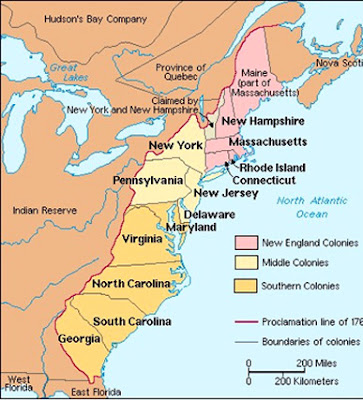
Colonial America: MAP
The northern group was called New England and included New Hampshire, Massachusetts, Rhode Island, and Connecticut. There were four Middle Colonies: New York, New Jersey, Pennsylvania, and Delaware. The South had five colonies: Maryland, Virginia, North Carolina, South Carolina, and Georgia. New England had small farms and focused on fishing, forestry (trees and lumber), shipping, and small industry to make money. The South had large plantation farms that grew tobacco and later cotton. Plantations were farmed first by indentured servants (people who would work for a period of years in return for passage to America and land), and later by slaves. The Middle Colonies had medium-sized farms. These colonies also had people from many different cultures with many different beliefs. All three regions were tied to the "Atlantic economy". Atlantic merchants used ships to trade slaves, tobacco, rum, sugar, gold, spices, fish, lumber, and manufactured goods between America, the West Indies, Europe and Africa.  New York, Philadelphia, Boston, and Charleston were the largest cities and main ports at that time.

Civil War:(US HISTORY)


In the election of 1860, the Democratic Party split and the Republican candidate for President, Abraham Lincoln, was elected. After this, many Southern states quit the Union. Eventually, eleven states quit. They started a new country called the Confederate States of America, or the "Confederacy". A war broke out between the Union (North) and the Confederacy (South). The South had better generals than the North, but it had fewer railroads and almost no weapons factories. Not having factories made it harder for Southern soldiers to get guns or uniforms. The South could not get supplies because Northern ships blockaded the Southern coast.
Civil War:(US HISTORY)
Early in the war, Confederate generals such as Robert E. Lee and Stonewall Jackson won battles over Union generals such as George B. McClellan and Ambrose Burnside who were not as good. In 1862 and 1863, the Union Army tried to take the Confederate capital of Richmond, Virginia several times, but failed each time. Lee's army invaded the North twice, but was turned back at Antietam and Gettysburg. In the middle of war, Lincoln made the Emancipation Proclamation, which supposedly freed all slaves in the Confederacy, and started letting black men fight in the Union Army. The war started going the Union’s way after the battles of Gettysburg and Vicksburg in 1863. Gettysburg stopped Lee from invading the North, and Vicksburg gave the Union control over the Mississippi River. In 1864, a Union Army under William T. Sherman marched through Georgia and destroyed much of it. By 1865, Union General Ulysses S. Grant had taken Richmond and forced Lee to give up the fight at Appomattox.

World War I:(US HISTORY)


 The United States did not want to enter World War I. It eventually entered the war in 1917 for two reasons. One was that a ship carrying Americans called the Lusitania was blown up by the Germans. The other was the Zimmerman Telegram, a message Germany sent to Mexico about invading the U.S. The United States fought on the side of Britain and France, and the war ended a year later. Wilson worked to create an international organization called the League of Nations.  The main goal of the League was preventing war. However, the United States did not join because isolationists rejected the peace treaty. At the end of World War I, a flu pandemic killed millions of people in the U.S. and Europe. After the war, the United States was one of the richest and most powerful nations in the world.

World War II:(US HISTORY)


As World War II was beginning, the United States said they would not get involved in it. Most Americans thought the United States should remain neutral, and some people thought the United States should enter the war on the side of the Germans. Eventually, the U.S. did try to help the Allied Powers (Soviet Union, Britain, and France) with the Lend Lease Act. It gave the Allies a lot of money and guns in trade for use of air bases throughout the world.

On December 7, 1941, Japan attacked Pearl Harbor, a U.S. base in Hawaii. The U.S. was no longer neutral, and it declared war on the Axis Powers (Germany, Japan, and Italy). The U.S. entering World War II ended the Great Depression because the war created many jobs. While some of the battles the U.S. fought in were air and naval battles with Japan, the U.S. mainly fought in Europe and Africa. The U.S. opened up several fronts, including in North Africa and Italy. The U.S. also bombed Germany from airplanes, blowing up German cities and factories. On June 6, 1944 (D-Day), American and British forces invaded Normandy. A year later, the Allies had freed France and taken Berlin. In 1945, Roosevelt died, and Harry Truman became president. The U.S. decided to drop two atomic bombs on Japan. Japan gave up soon afterwards, and the war ended. However, the atomic bombs killed many ordinary people in the cities, not only soldiers. At least 250,000 Japanese people died in four days.
The war meant different things for women and minorities. During the war, many women worked in weapons factories. They were symbolized by a character called "Rosie the Riveter". Many African-Americans served in the army, but often in segregated units with white officers. Japanese-Americans on the West Coast were forced to live in internment camps, though a few also served in the Army.

Postwar era (1945–1991):(US HISTORY)

Cold War:(US HISTORY)


After World War II, the Soviet Union and the United States were the two most powerful countries left in the world. The Cold War was a period of tension between the two countries over ways of life. The two countries tried to get other countries on their side. The Soviet Union tried to get countries to become Communist and the United States tried to stop them from being Communist. American and Soviet soldiers never fought in battles, but they fought indirectly in the Korean War (1950s) and the Vietnam War (1950s–1970s).
Cold War:(US HISTORY)
The Korean War lasted only a few years, but led to American soldiers being in Korea since then. The Vietnam War lasted much longer. It started with a few American troops in Vietnam, but by the 1960s thousands of Americans were being sent to Vietnam. Both wars were between a Northern Communist government helped by the Soviet Union and Communist China and a Southern government helped by the U.S. The Korean War resulted in a split Korea, but the Vietnam War resulted in a Communist Vietnam after the United States left due to American people wanting to end the war. Over a quarter million Americans died or were wounded in Vietnam, which was very much a military failure. The U.S. and Soviet Union argued about where they could place nuclear weapons. One of these arguments was the Cuban Missile Crisis. During the Cuban Missile Crisis, the U.S. and Soviet Union came very close to attacking each other with nuclear weapons.

Tuesday, 16 July 2013

What Was World War I:

History of World War I
World War I was an extremely bloody war that engulfed Europe from 1914 to 1919, with huge losses of life and little ground lost or won. Fought mostly by soldiers in trenches, World War I saw an estimated 10 million military deaths and another 20 million wounded. While many hoped that World War I would be "the war to end all wars," in actuality, the concluding peace treaty set the stage for World War II.

The Start of World War I:(World War I)


The spark that started World War I was the assassination of Austria's Archduke Franz Ferdinand and his wife Sophie. The assassination occurred on June 28, 1914 while Ferdinand was visiting the city of Sarajevo in the Austro-Hungarian province of Bosnia-Herzegovina.

Although Archduke Franz Ferdinand, the nephew of Austria's emperor and heir-apparent to the throne, was not very well liked by most, his assassination by a Serb nationalist was viewed as a great excuse to attack Austria-Hungary's troublesome neighbor, Serbia.

However, instead of reacting quickly to the incident, Austria-Hungary made sure they had the backing of Germany, with whom they had a treaty, before they proceeded. This gave Serbia time to get the backing of Russia, with whom they had a treaty

Friday, 12 July 2013

History of Europe 

European History
European History
The history of Europe covers the people inhabiting the European continent since it was first populated in prehistoric times to present, with the first Homo sapiens arriving between 45,000 and 25,000 BC.

The earliest settlers to Prehistoric Europe came during the paleolithic era. The arrival of agriculture around 7000 BC ushered in theneolithic age. Neolithic Europe lasted for 4000 years, overlapping with metal-using cultures that gradually spread throughout the continent. Technological advances during the prehistoric age tended to arrive from the Middle East, spreading gradually to the northwest. Some of the best-known civilizations of prehistoric Europe were Minoan and Mycenaean, which flourished during the Bronze Age until theycollapsed in a short period of time around 1200 BC.

The period known as classical antiquity began with the rise of the city-states of Ancient Greece. Greek influence reached its zenith under the expansive empire of Alexander the Great, spreading throughout Asia. Northern and western Europe were dominated by the La Tène culture, a precursor to the Celts. Rome, a small city-state traditionally founded in 753 BC, would grow to become the Roman Republic in 509 BC and would succeed Greek culture as the dominant Mediterranean civilization. The events of the rule of Julius Caesar led to reorganization of the Republic into the Roman Empire. The empire was later divided by the emperor Diocletian into the Western andEastern empires. During the later years of the Roman Empire, the Germanic peoples of northern Europe grew in strength and repeated attacks led to the Fall of the Western Roman Empire in AD 476, a date which traditionally marks the end of the classical period and the start of the Middle Ages.

Monday, 24 June 2013

Mr.OBAMA

Mr.Obama

Barack Hussein Obama II is the 44th and current President of the United States, the first African American to hold the office. Wikipedia
Born: August 4, 1961 (age 51), Honolulu, Hawaii, United States
Full name: Barack Hussein Obama II
Previous office: Senator (IL) 2005–2008
Office: President of the United States since 2009
Parents: Barack Obama Sr., Ann Dunham
Education: Harvard Law School (1988–1991), Columbia University (1981–1983), Occidental College (1979–1981), Punahou School (1971–1979), State Elementary School Menteng 01 (1970–1971), St. Francis of Assisi Catholic School (1968–1970), Noelani Elementary School (1966–1967)

Barack Hussein Obama

Obama is a Great man and President of the United States since 2009. Obama is a noble person not only in bookish language also in actual faith.Anyone can check his update status and his prestigious life history that how this renowned and noble person done work and got this position with the faith of people and grace of Load.

Friday, 14 June 2013

CHILD LABOR

Child Labor

God has given human beings the boon of wisdom and discretion to think upon the signs of the universe and to draw conclusions. That is the reason why they disclose the hidden facts of it and its structure and have made remarkable progress in many walks of life. Children are the flowers of heaven. They are the most beautiful and purest creation of God. They are innocent both inwardly and outwardly. No doubt, they are the beauty of this world. Early in the morning when the children put on different kinds of clothes and begin to go to schools for the sake of knowledge, we feel a specific kind of joy through their innocence.

But there are also other children, those who cannot go to schools due to financial problems, they only watch others go to schools and can merely wish to seek knowledge.It is due to many hindrances and difficulties; desperate conditions that they face in life. Having been forced to kill their aspirations, dreams and other wishes, they are pressed to earn a living for themselves and for their families. It is also a fact that there are many children who play a key role in sustaining the economically life of their family without which, their families would not be able to make ends meet. These are also part of our society who have forgotten the pleasures of their childhood. When a child in addition to getting education, earns his livelihood, this act of earning a livelihood is called as child Labour.

What is Child Labor?

Child labor is work that harms children or keeps them from attending school. Around the world and in the U. S., growing gaps between rich and poor in recent decades have forced millions of young children out of school and into work. The International Labor Organization estimates that 215 million children between the ages of 5 and 17 currently work under conditions that are considered illegal, hazardous, or extremely exploitative. Underage children work at all sorts of jobs around the world, usually because they and their families are extremely poor. Large numbers of children work in commercial agriculture, fishing, manufacturing, mining, and domestic service. Some children work in illicit activities like the drug trade and prostitution or other traumatic activities such as serving as soldiers.

Another definition states:(Child Labor)

“Child Labour” is generally speaking work for children that harms them or exploits them in some way (physically, mentally, morally or blocking access to education),
United Nations International Children’s Emergency Fund(UNICEF) defines “child” as anyone below the age of 18, and “child Labour” as some type of work performed by children below age 18. (UNICEF)

Child Labor in U.S. History

Forms of child labor, including indentured servitude and child slavery, have existed throughout American history. As industrialization moved workers from farms and home workshops into urban areas and factory work, children were often preferred, because factory owners viewed them as more manageable, cheaper, and less likely to strike. Growing opposition to child labor in the North caused many factories to move to the South. By 1900, states varied considerably in whether they had child labor standards and in their content and degree of enforcement. By then, American children worked in large numbers in mines, glass factories, textiles, agriculture, canneries, home industries, and as newsboys, messengers, bootblacks, and peddlers.
CHILD LABOR

Wednesday, 22 May 2013

London


London Listeni/ˈlʌndən/ is the capital city of England and the United Kingdom, and the largest city, urban zone and metropolitan area in the United Kingdom, and the European Union by most measures. Located on the River Thames, London has been a major settlement for two millennia, its history going back to its founding by the Romans, who named it Londinium.London's ancient core, the City of London, largely retains its square-mile mediaeval boundaries. Since at least the 19th century, the name London has also referred to the metropolis developed around this core. The bulk of this conurbation forms the London region and the Greater London administrative area, governed by the elected Mayor of London and the London Assembly.

London is a leading global city, with strengths in the arts, commerce, education, entertainment, fashion, finance, healthcare, media, professional services, research and development, tourism and transport all contributing to its prominence.It is one of the world's leading financial centres and has the fifth- or sixth-largest metropolitan area GDP in the world depending on measurement.London has been described as a world cultural capital. It is the world's most-visited city as measured by international arrivals and has the world's largest city airport system measured by passenger traffic. London's 43 universities form the largest concentration of higher education in Europe. In 2012, London became the first city to host the modern Summer Olympic Games three times.

London has a diverse range of peoples and cultures, and more than 300 languages are spoken within its boundaries. London had an official population of 8,174,100, making it the most populous municipality in the European Union,and accounting for 12.5% of the UK population. The Greater London Urban Area is the second-largest in the EU with a population of 8,278,251,while the London metropolitan area is the largest in the EU with an estimated total population of 15,010,295. London had the largest population of any city in the world from around 1831 to 1925.

London contains four World Heritage Sites: the Tower of London; Kew Gardens; the site comprising the Palace of Westminster, Westminster Abbey, and St Margaret's Church; and the historic settlement of Greenwich (in which the Royal Observatory marks the Prime Meridian, 0° longitude, and GMT). Other famous landmarks include Buckingham Palace, the London Eye, Piccadilly Circus, St Paul's Cathedral, Tower Bridge, Trafalgar Square, and The Shard. London is home to numerous museums, galleries, libraries, sporting events and other cultural institutions, including the British Museum, National Gallery, Tate Modern, British Library and 40 West End theatres. The London Underground is the oldest underground railway network in the world.


London Map

CityMap will help you interactively locate museums, shopping malls, libraries, parks, sports facilities and other points of interest. Bicycling and walking routes and downtown parking locations are among the specialized services of CityMap that you can navigate to via the page links on the left.


London Eye


The structure was designed by the architectural team of David Marks and Julia Barfield, husband and wife.
They submitted their idea for a large observation wheel as part of a competition to design a landmark for the new millennium.
None of the entrants won the competition, but the couple pressed on and eventually got the backing of British Airways, who sponsored the project.

The London Eye is a giant Ferris wheel situated on the banks of the River Thames in London, England. The entire structure is 135 metres (443 ft) tall and the wheel has a diameter of 120 metres (394 ft).

It is the tallest Ferris wheel in Europe, and the most popular paid tourist attraction in the United Kingdom, visited by over 3.5 million people annually. When erected in 1999 it was the tallest Ferris wheel in the world, until surpassed first by the 160 m (520 ft) Star of Nanchang in 2006 and then the 165 m (541 ft) Singapore Flyer in 2008. Supported by an A-frame on one side only, unlike the taller Nanchang and Singapore wheels, the Eye is described by its operators as "the world's tallest cantilevered observation wheel". It offered the highest public viewing point in the city[citation needed] until it was superseded by the 245-metre (804 ft) observation deck on the 72nd floor of The Shard, which opened to the public on 1 February 2013.

The London Eye, or Millennium Wheel, was officially called the British Airways London Eye and then the Merlin Entertainments London Eye. Since 20 January 2011, its official name is the EDF Energy London Eye following a three-year sponsorship deal.

The London Eye adjoins the western end of Jubilee Gardens, on the South Bank of the River Thames between Westminster Bridge and Hungerford Bridge, in the London Borough of Lambeth. The site is adjacent to that of the former Dome of Discovery, which was built for the Festival of Britain in 1951.

Sunday, 19 May 2013

Flag of ENGLAND


England (Listeni/ˈɪŋɡlənd/) is a country that is part of the United Kingdom. It shares land borders with Scotland to the north and Wales to the west. The Irish Sea lies north west of England, whilst the Celtic Sea lies to the south west. The North Sea to the east and the English Channel to the south separate it from continental Europe. Most of England comprises the central and southern part of the island of Great Britain in the North Atlantic. The country also includes over 100 smaller islands such as the Isles of Scilly, and the Isle of Wight.

The area now called England was first inhabited by modern humans during the Upper Palaeolithic period, but it takes its name from the Angles, one of the Germanic tribes who settled during the 5th and 6th centuries. England became a unified state in 927 AD, and since the Age of Discovery, which began during the 15th century, has had a significant cultural and legal impact on the wider world. The English language, the Anglican Church, and English law - the basis for the common law legal systems of many other countries around the world - developed in England, and the country's parliamentary system of government has been widely adopted by other nations.The Industrial Revolution began in 18th-century England, transforming its society into the world's first industrialised nation.
Stephen's Tower England

England And London


London Listeni/ˈlʌndən/ is the capital city of England and the United Kingdom, and the largest city, urban zone and metropolitan area in the United Kingdom, and the European Union by most measures. Located on the River Thames, London has been a major settlement for two millennia, its history going back to its founding by the Romans, who named it Londinium. London's ancient core, the City of London, largely retains its square-mile mediaeval boundaries. Since at least the 19th century, the name London has also referred to the metropolis developed around this core.The bulk of this conurbation forms the London region and the Greater London administrative area,governed by the elected Mayor of London and the London Assembly.
Great Britin Photo

London is a leading global city, with strengths in the arts, commerce, education, entertainment, fashion, finance, healthcare, media, professional services, research and development, tourism and transport all contributing to its prominence. It is one of the world's leading financial centres and has the fifth- or sixth-largest metropolitan area GDP in the world depending on measurement.London has been described as a world cultural capital. It is the world's most-visited city as measured by international arrivals and has the world's largest city airport system measured by passenger traffic. London's 43 universities form the largest concentration of higher education in Europe. In 2012, London became the first city to host the modern Summer Olympic Games three times.

London Today

Many say today London is a swinging, cosmopolitan, safe, fashionable capital city. Traffic is appalling but no worse than any other similar urban centre. London is also dirty but is much cleaner than it was 25 years ago. (The English are simply fun loving dirty people compared with the Swiss and the Swedish.)

Living In London

Living now in London is now better than it ever has been both for the rich and the poor, with poverty extremes being almost non existent. Even so there are still probably some 50,000 people sleeping rough on the London streets every night. Ethnic minorities sleeping rough are in the minority.
Planners have tried to re-create small village areas within London to enhance the environment for those who live in the centre very often by establishing traffic free (or traffic restricted) zones supported by local shops and pubs but no new churches. Indeed based on the numbers of people who now go to church, London and elsewhere in England is a secular society. Two good examples of new village areas are in Holborn, north of Theobald's road and north of Oxford street and east of Baker street. These should be added to the fashionable village areas of Kensington and Notting Hill as well as the less fashionable, but swinging Bayswater and Camden. (There are many more examples)

London Transport

What is the solution to the mass movement of people in a city? Bikes perhaps!! Yes even in cold wet London the use of pedal power made a come back some 10 years ago on the backs of a general revival, fuelled by fashionable, off road mountain bikes. A bike is probably the best, safety excepted, for the young to travel up to say 10 miles in the metropolis. Unfortunately bike lanes are few and far between and theft is an issue particularly of desirable £500 plus bikes.

The Tube (Metro) in London is extensive but is mainly over 100 years old and is very slow and crowded. A solution would be to rebuild on new tracks through existing tunnels. This has been done to some extent on the Northern Line which boasts new rolling stock and on the Jubilee Line which was extended out to Greenwich via the old Surrey Docks for the Millennium Dome exhibition. The left wing Mayor, Ken Livingstone should be given credit for fighting Central Government to achieve a unified management structure, with clear accountability, to run London's Tube Trains. Unfortunately, however, no radical plans have been produced to say double the potential capacity of the service as might be possible with a radical increase of the speed of the rolling stock.

Population and Housing in London 

There are no plans to further reduce the population of London. Indeed the numbers of people living in central London is on the increase particularly amongst the better off as the urban village environments and other schemes start to work. The use of high rise developments for high class living is virtually nil other than in the Docklands. The poor also prefer terraced-style housing of which there is plenty and indeed poor inhabitants living in the high-rises that have been built sometimes have to stomach dirty and violent surroundings. Major international companies on the other hand, like inhabiting high rise office blocks and London Mayor Ken Livingstone is working with architects to determine the best areas in London for office Sky Scrapers. The opposition is the English National Heritage.

London peoples are multi-cultured and multi-coloured. On the fringes there is full integration with inter-marriages particularly where religion is not an issue. In the main however the new races keep to invisibly separated territories and happily meet in the central shopping precincts and in the workplace. The big boost to workplace integration came with the advent of the computer which required a new breed of intelligence to write software code that could therefore be satisfied by any social class, colour, religion or sex. Indeed in the computer world there are no obvious top dogs between men and women, rich or poor, whites, blacks, browns, Chinese or Japanese, Christians, Muslims or any other group. This might be the start of something good! London has its fair share of software companies to further this integration.
Walking the streets of London it is also very encouraging to see many slim, well dressed, healthy and attractive people from all races mingling with equality of opportunity round every corner. (Obviously there are exceptions to this generalisation notably amongst the poorly educated inner city inhabitants. Whose fault is it, their parents or the government?)

London Shopping

One of the attractions to London is shopping. Top shops, in for example Oxford Street (Selfridges and Marks and Spencer), Regents Street (Hamleys, Libertys and Lillywhites), Piccadilly(Hatchards), Knightsbridge(Harrods) are a match for any shop in any country in the world. This is of course only a small sample of the best known shops and there are a multitude of smaller specialist shops catering for every need of men and women. All these are central in the West End and easily and cheaply reached by Tube, Taxi, Bus, Bike or on foot.

London Theatre

London is perhaps the best in the world for live plays as the English repertory companies are known to give the best training for this art. Theatre Land is centred round Shaftsbury Avenue which runs north east out of Piccadilly. There are small Theatres to be found all over London which include of course the rebuilt Shakespeare's Globe Theatre in historic Southwark and the Young Vic south of Waterloo Bridge.


Friday, 17 May 2013

Sphinx

A History of the Great Sphinx of Giza


The Great Sphinx stands on the Giza Plateau, a stone's throw away from the Great Pyramids of Egypt. The statue faces directly east, some speculate as a guardian of the temple and pyramids that surround it.

When the ancients first came into the contact with this statue, a massive creature with the body of a lion and the head of a man they called it a Sphinx. In Greek mythology a sphinx is a winged creature with the body of a lion and the head of a woman. Gender differences withstanding the name Sphinx has been applied to the lion-man statue at Giza and to all similar statues found in Egypt.

What name the Egyptians originally gave the Sphinx is unknown. The earliest Egyptian writings mentioning the Sphinx come from almost a millennium after its original building and refer to it by several names: Hor-em-akht (Horus in the Horizon), Bw-How (Place of Horus) and Ra-horakhty (Ra of Two Horizons).

No other sphinx statue found in Egypt is either as old or as large as the Great Sphinx of Giza. It stands 65 feet tall, 20 feet wide and an astounding 260 feet long. Estimates of its weight (not precisely known) range upwards of 200 tons, making it one of the largest single stone sculptures in the world.

Origins of the Great Sphinx of Giza


Thursday, 16 May 2013


King Tutankhamen

King Tutankhamen

King Tutankhamen (or Tutankhamun) ruled Egypt as pharaoh for 10 years until his death at age 19, around 1324 B.C. Although his rule was notable for reversing the tumultuous religious reforms of his father, Pharaoh Akhenaten, Tutankhamen’s legacy was largely negated by his successors. He was barely known to the modern world until 1922, when British archaeologist Howard Carter chiseled through a doorway and entered the boy pharaoh's tomb, which had remained sealed for more than 3,200 years. The tomb's vast hoard of artifacts and treasure, intended to accompany the king into the afterlife, revealed an incredible amount about royal life in ancient Egypt, and quickly made King Tut the world's most famous pharaoh.

King Tut: Royal Lineage

Genetic testing has verified that King Tut was the grandson of the great pharaoh Amenhotep II, and almost certainly the son of Akhenaten, a controversial figure in the history of the 18th dynasty of Egypt’s New Kingdom (c.1550-1295 B.C.). Akhenaten upended a centuries-old religious system to favor worship of a single deity, the sun god Aten, and moved Egypt's religious capital from Thebes to Amarna. After Akhenaten's death, two intervening pharaohs briefly reigned before the 9-year-old prince, then called Tutankhaten, took the throne.
Early in his reign Tutankhamen reversed Akhenaten's reforms, reviving worship of the god Amun, restoring Thebes as a religious center and changing the end of his name to reflect royal allegiance to the creator god Amun. He also worked in concert with his powerful advisers Horemheb and Ay—both future pharaohs—to restore Egypt’s stature in the region.

King Tut: Illnesses and Death

King Tut was tall but physically frail, with a crippling bone disease in his clubbed left foot. He is the only pharaoh known to have been depicted seated while engaged in physical activities like archery. Traditional inbreeding in the Egyptian royal family also likely contributed to the king's poor health and early death. DNA tests published in 2010 revealed that Tutankhamen's parents were brother and sister and that his wife, Ankhesenamun, was also his half-sister. Their only two daughters were stillborn.
Because Tutankhamen's remains revealed a hole in the back of the skull, some historians had concluded that the young king was assassinated, but recent tests suggest that the hole was made during mummification. CT scans in 1995 showed that the king had an infected broken left leg, while DNA from his mummy revealed evidence of multiple malaria infections, all of which may have contributed to his early death.

King Tut: Mummy and Tomb

After he died, King Tut was mummified according to Egyptian religious tradition, which held that royal bodies should be preserved and provisioned for the afterlife. Embalmers removed his organs and wrapped him in resin-soaked bandages, a 24-pound solid gold portrait mask was placed over his head and shoulders and he was laid in a series of nested containers—three golden coffins, a granite sarcophagus and four gilded wooden shrines, the largest of which barely fit into the tomb's burial chamber.
Because of his tomb’s small size, historians suggest King Tut’s death must have been unexpected and his burial rushed by Ay, who succeeded him as pharaoh. The tomb’s antechambers were packed to the ceiling with more than 5,000 artifacts, including furniture, chariots, clothes, weapons and 130 of the lame king's walking sticks. The entrance corridor was apparently looted soon after the burial, but the inner rooms remained sealed. The pharaohs who followed Tut chose to ignore his reign, as despite his work restoring Amun, he was tainted by the connection to his father’s religious upheavals. Within a few generations, the tomb's entrance had been clogged with stone debris, built over by workmen's huts and forgotten.

King Tut's Tomb: Rediscovery and Renown

By the time he discovered Tutankhamen’s tomb in 1922, British archaeologist Howard Carter had been excavating Egyptian antiquities for three decades. At the time of the discovery, archaeologists believed that all the royal tombs in the Valley of the Kings, across the river from ancient Thebes, had already been cleared. Excitement about the new tomb—the most intact ever found—quickly spread worldwide. It took Carter and his team a decade to catalogue and empty the tomb.
Artifacts from King Tut's tomb have toured the world in several blockbuster museum shows, including the worldwide 1972-79 "Treasures of Tutankhamun" exhibitions. Eight million visitors in seven U.S. cities viewed the exhibition of the golden burial mask and 50 other precious items from the tomb. Today the most fragile artifacts, including the burial mask, no longer leave Egypt. Tutankhamen's mummy remains on display within the tomb, his layered coffins replaced with a climate-controlled glass box.

Wednesday, 15 May 2013


Did you know that, prior to the 19th century, ancient mummies got none of the respect they have today? Rather than preserving them in museums, people would unwrap mummies and exploit their various parts. Their bones were ground up into powder and sold as medicine, and their wrappings were used to make paint. Some even say that early American paper manufacturers imported Egyptian mummies and made wrapping paper out of their bindings. Thankfully, these practices died out and mummies came to be seen as precious artifacts, which paved the way for some of the most remarkable discoveries in history.

Ginger

Nicknamed for its red hair, "Ginger" is the most famous of six naturally mummified bodies excavated in the late 19th century from shallow graves in the Egyptian desert. It went on display at the British Museum in 1901, becoming the first mummy to be exhibited in public, and has stayed there ever since. Ginger and the other bodies found with it are the oldest known mummies in existence, dating back to about 3400 B.C. Artificial mummification was not yet a common practice at the time of their deaths, but their bodies were naturally dried and preserved by the warm sand in which they were buried.

Hatshepsut


 The most prominent female pharaoh, Hatshepsut reigned over Egypt for roughly two decades, undertaking ambitious building projects and establishing valuable new trade routes until her death in 1458 B.C. The archaeologist Howard Carter discovered her royal tomb in Egypt's Valley of the Kings in 1902. When he located her sarcophagus some years later, however, it was found to be empty. Carter also unearthed a separate tomb, known as KV60, which contained two coffins: that of Hatshepsut's wet nurse–identified as such by an inscription on its cover–and that of an unknown female. In 2006, a team led by Dr. Zahi Hawass set out to determine whether the anonymous woman in KV60 could be the missing queen herself. The vital piece of evidence was a molar tooth found in a wooden box bearing Hatshepsut's name. When Awass and his colleagues compared the tooth to a gap in the mummy's upper jaw, it was a perfect fit, leading the researchers to conclude that the search for Hatshepsut was finally over.

Ramesses II


Regarded by many historians as Egypt's most powerful pharaoh, Ramesses II reigned for six decades (c. 1279-1213 B.C.), lived to be over 90 years old and is said to have fathered upwards of 100 children. His body was originally entombed in the Valley of the Kings, as was customary for a pharaoh, but ancient Egyptian priests later moved it to thwart rampant looters. In 1881, Ramesses II's mummy was discovered in a secret royal cache at Deir el-Bahri, along with those of more than 50 other rulers and nobles. In 1974, archeologists noticed its deteriorating condition and flew it to Paris, where it was treated for a fungal infection. Before the journey, Ramesses II was issued an Egyptian passport, which listed his occupation as "King (deceased)."

Valley of the Golden Mummies

Bahariya Oasis

Located in Egypt's Western Desert, the Bahariya Oasis was a major agricultural center during ancient times and is now home to several archaeological sites, including a Greek temple dedicated to Alexander the Great. In 1996, an antiquities guard was riding his donkey on the temple's grounds. Suddenly, the donkey's leg stumbled into a hole, revealing an opening in the desert floor and the edge of a tomb. A team of archaeologists led by Dr. Zahi Hawass began excavations of the site, known as the Valley of the Golden Mummies. The first few expeditions have uncovered several hundred mummies that date back to Egypt's Greco-Roman period, as well as a treasure trove of artifacts. The diversity of the mummies' adornments suggests that the site served as the final resting place for every level of society, including wealthy merchants, members of the middle class and poorer inhabitants. Hawass estimates that as many as 10,000 additional mummies may be lying under the sand.

    Blogger news

    About

    this blog reveals education , knowledge sharing on multi topics